
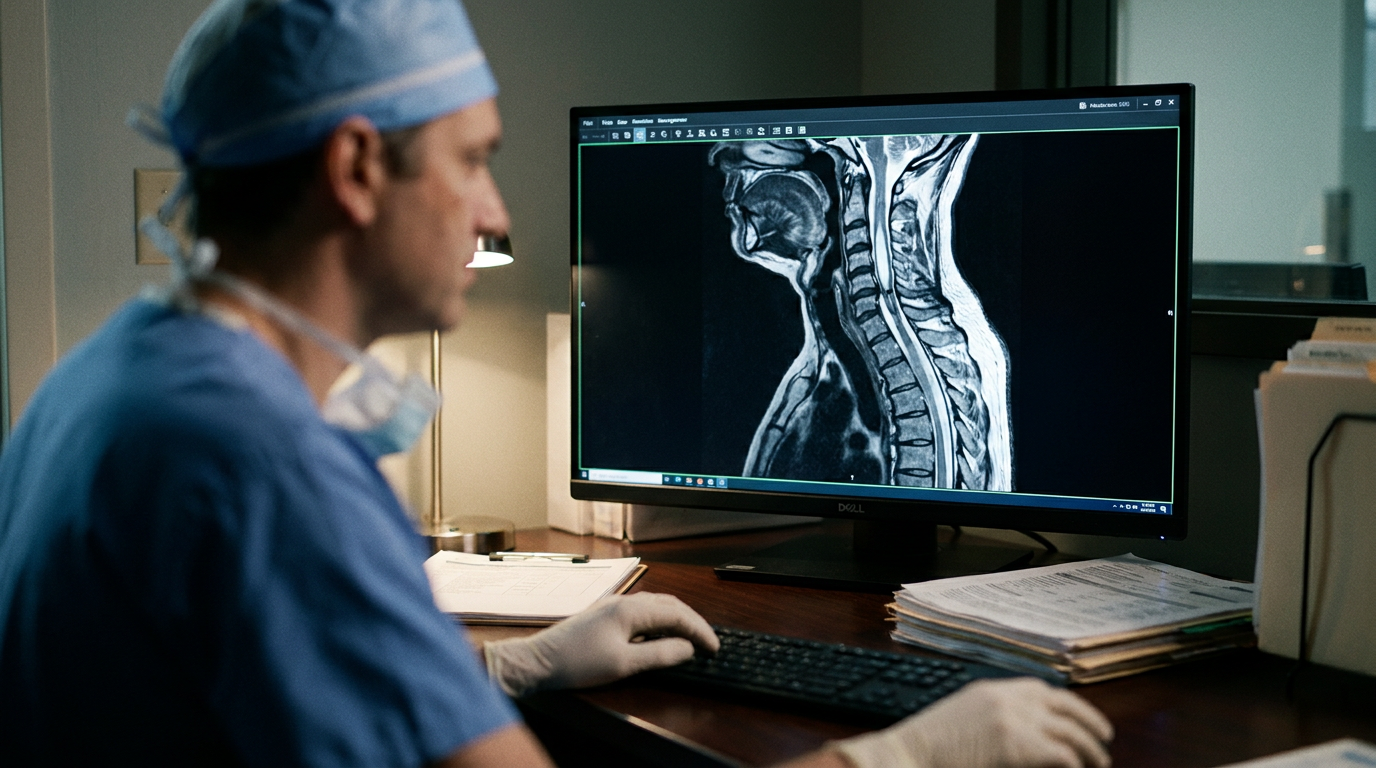
- This study addressed the poorly defined comparative outcomes across different shunt types for syringomyelia.
- Researchers conducted a retrospective review of 31 patients who underwent 48 syrinx shunt surgeries.
- Syringopleural shunts had the highest revision rate at 55.0% (p = 0.003), despite showing 55.0% early motor/sensory improvement.
- The authors concluded that syrinx shunting offered modest early neurological benefit, but long-term durability remained limited.
- Optimizing patient selection and vigilant postoperative monitoring are crucial for improving durable outcomes in syringomyelia shunting.
Navigating Syringomyelia: Shunt Choices and Clinical Realities
Syringomyelia, a progressive disorder marked by fluid-filled cavities within the spinal cord, often requires surgical intervention to halt neurological decline [1, 2]. When posterior fossa decompression is insufficient or inappropriate, particularly in cases not associated with Chiari malformation, shunting the syrinx remains a primary treatment [3, 4]. Clinicians and surgeons must choose between diverting fluid to the pleural space (syringopleural), the subarachnoid space (syringosubarachnoid), or the peritoneal cavity (syringoperitoneal). This decision is complicated by a lack of robust comparative data, with existing evidence presenting a mixed picture. For instance, one systematic review suggested similar clinical outcomes but noted that syringoperitoneal shunts had a greater rate of malfunction requiring revision [1, 5]. A recent study, however, found that while syringopleural shunts offered more immediate clinical improvement, they also carried a higher revision risk [6]. This ambiguity underscores the need for clearer data to guide treatment planning and patient counseling [1, 7].
Study Design and Patient Cohort Characteristics
To clarify the relative performance of different syrinx shunts, researchers performed a retrospective analysis of a prospectively maintained database from a single senior surgeon. This approach, using data collected consistently from 1997 to 2025, minimizes variability in surgical technique and data recording. The study aimed to compare revision rates, time to failure, and neurological outcomes among the three primary shunt types. A revision was defined as any return to the operating room for a shunt-related complication. The cohort included 31 patients (19 male, mean age 47.2 years) who underwent a total of 48 shunt placement surgeries. The procedures were distributed among 20 syringopleural (41.7%), 21 syringosubarachnoid (43.8%), and 7 syringoperitoneal (14.6%) shunts. The underlying etiologies for syringomyelia were most commonly traumatic injury and Chiari malformation.
Differential Revision Rates and Hospital Stays
Analysis of surgical outcomes revealed a significant divergence in the durability of the shunts. Overall, nearly a third of patients, 10 of 31 (32.2%), required at least one revision surgery. The risk of revision, however, was not uniform across procedures. Syringopleural shunts had the highest revision rate at 55.0%, a stark contrast to the 28.6% rate for syringoperitoneal shunts and the 19.0% rate for syringosubarachnoid shunts. This disparity in needing a reoperation was statistically significant (p = 0.003). In terms of timing, syringoperitoneal shunts that failed did so quickly (mean 89 days), while syringopleural shunts lasted much longer before revision (mean 1093 days), though these differences in timing were not statistically significant (p = 0.144). In a notable counterpoint to the revision data, patients receiving syringopleural shunts had a significantly shorter mean hospital stay of 5.4 days compared to 10.1 days for syringosubarachnoid and 10.0 days for syringoperitoneal placements (p = 0.036), suggesting a faster initial recovery for the procedure with the highest long-term failure rate.
Neurological Outcomes: Early Gains vs. Long-Term Durability
When evaluating patient function, the study distinguished between immediate and lasting neurological benefits. A trend toward better early outcomes was seen with syringopleural shunts, where 55.0% of cases experienced early motor and/or sensory improvement. This compares to 33.3% of syringosubarachnoid cases and 14.3% of syringoperitoneal cases. However, this apparent advantage for syringopleural shunts did not reach statistical significance (p = 0.117). The more definitive and sobering finding concerned long-term results. The authors report that sustained long-term neurological improvement was rare across all three shunt groups (p = 0.551), a critical point for managing patient expectations. These findings create a complex clinical trade-off: syringopleural shunts offered the greatest chance of early, albeit not statistically significant, improvement but also carried the highest risk of future revision surgery. Conversely, syringosubarachnoid shunts proved more mechanically durable but were associated with more limited initial clinical efficacy.
Clinical Implications and Future Directions
This analysis provides clinicians with a more granular, evidence-based framework for discussing syrinx shunting with patients. The data confirm that while shunting can provide modest early neurological relief, achieving durable improvement remains a significant challenge. The choice of shunt involves a direct trade-off. Syringopleural shunts may be favored for patients prioritizing the possibility of immediate symptom relief, but this must be weighed against a 55.0% revision rate. In contrast, a syringosubarachnoid shunt offers a lower likelihood of reoperation (19.0% revision rate) but may provide less initial functional gain. Syringoperitoneal shunts, the least common in this series, failed the fastest on average when they did fail. Critically, the finding that sustained long-term improvement was rare across all groups (p = 0.551) highlights that no current shunting technique is a definitive cure. The authors conclude that optimizing patient selection for a specific shunt type and maintaining vigilant postoperative monitoring are essential. The results call for further research to refine surgical strategies and improve the long-term durability of outcomes for this challenging condition.
References
1. Rothrock RJ, Lu VM, Levi AD. Syrinx shunts for syringomyelia: a systematic review and meta-analysis of syringosubarachnoid, syringoperitoneal, and syringopleural shunting. Journal of Neurosurgery Spine. 2021. doi:10.3171/2020.12.spine201826
2. Fadila M, Sarrabia G, Shapira S, et al. Orthopedic Manifestations of Syringomyelia: A Comprehensive Review. Journal of Clinical Medicine. 2025. doi:10.3390/jcm14093145
3. Alzain A, Halabieh S, Hamoud W, et al. Posterior Fossa Decompression Versus Syringo-Subarachnoid Shunt for Chiari I-associated Syringomyelia: A Systematic Review. Cureus. 2025. doi:10.7759/cureus.99276
4. Zhang F, Norvell DC, Hermsmeyer JT, Schuster JM. Persistent/Recurrent Syringomyelia after Chiari Decompression—Natural History and Management Strategies: A Systematic Review. Evidence-Based Spine-Care Journal. 2013. doi:10.1055/s-0033-1357362
5. Rothrock R, Lu VM, Levi A. Syrinx shunts for syringomyelia: a systematic review and meta-analysis of syringosubarachnoid, syringoperitoneal, and syringopleural shunting.. 2021. doi:10.3171/2020.12.SPINE201826
6. Khalafallah AM, Dusseau NB, Narayanan D, Dower A, Levi AD. Comparative outcomes of syringopleural, syringosubarachnoid, and syringoperitoneal shunts for syringomyelia: a single-center retrospective cohort study. Journal of neurosurgery. 2026. doi:10.3171/2025.12.jns252016
7. Ananda S, Iskandar, Hamzah Z. Surgical Procedure And Future Treatment Options For Posttraumatic Syringomyelia : A Systematic Review. Asian Australasian Neuro and Health Science Journal (AANHS-J). 2022. doi:10.32734/aanhsj.v4i2.8855