
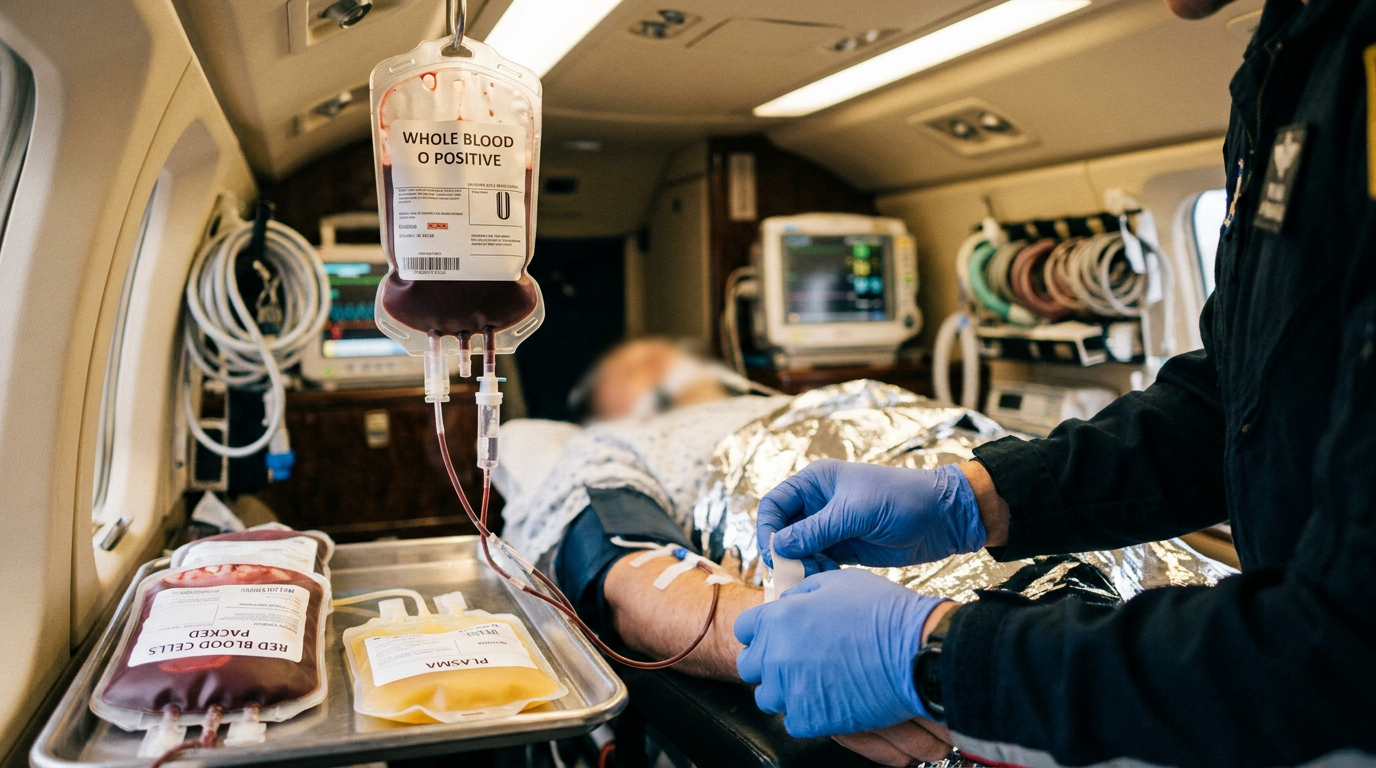
- The study addressed whether prehospital whole blood transfusion improves outcomes compared to blood components for traumatic hemorrhage.
- This phase 3, cluster-randomized trial involved 44 air medical bases and analyzed 993 trauma patients for 30-day mortality.
- 30-day mortality was 25.9% with whole blood versus 20.5% with components (adjusted odds ratio, 1.24; P = 0.24).
- The researchers concluded that prehospital whole blood did not reduce 30-day mortality compared to blood components.
- Clinicians should note that whole blood offers no mortality benefit over components for prehospital trauma transfusion.
Prehospital Transfusion for Traumatic Hemorrhage: Reassessing Whole Blood's Role
For patients with severe traumatic hemorrhage, early resuscitation with blood products before hospital arrival is a critical, life-saving intervention [1, 2, 3, 4]. The standard of care has long been component therapy, which involves administering red blood cells, plasma, and platelets as separate units [5]. In recent years, however, there has been a resurgence of interest in using whole blood for prehospital transfusion, based on the logistical simplicity and theoretical benefit of providing a balanced ratio of clotting factors and cells in a single bag [6, 7, 8]. Despite its increasing use by some emergency medical services, robust trial data directly comparing prehospital whole blood to component therapy for the key outcome of patient survival have been lacking [9, 10].
Study Design and Patient Cohort
To address this evidence gap in a real-world setting, investigators conducted a pragmatic, multicenter, phase 3 trial. The design was cluster-randomized, meaning entire air medical bases, rather than individual patients, were assigned to an intervention to prevent treatment crossover. A total of 44 air medical bases were randomized in a 2:1 ratio to use either up to 2 units of whole blood or as-indicated blood components (plasma, red cells, or both) for trauma patients. The assigned product was used for 1-month blocks before switching, a method designed to ensure staff familiarity and adherence. The primary endpoint was straightforward and clinically definitive: all-cause mortality at 30 days post-randomization. Of the 1020 eligible patients transported by these services, 715 were in the whole-blood group and 305 were in the component group. The final primary analysis included 695 and 298 patients, respectively.
Primary Outcome: No Mortality Difference Observed
The study's primary analysis did not demonstrate a survival advantage for prehospital whole blood transfusion in patients with hemorrhagic shock. The 30-day mortality rate was 25.9% in the whole-blood group compared to 20.5% in the component therapy group. After adjusting for potential confounders, this difference was not statistically significant. The adjusted odds ratio for 30-day mortality was 1.24 (95% confidence interval [CI], 0.87 to 1.76; P = 0.24), indicating that the odds of death were not significantly different between the two treatment arms. Importantly for clinical practice, the researchers also found no substantial differences in the rates of adverse events between the groups, suggesting that both transfusion strategies have comparable safety profiles in the prehospital environment.
Storage Age and Mortality: An Observational Substudy
A persistent question in transfusion medicine is whether the age of stored blood, often associated with a 'storage lesion' involving biochemical and structural changes, affects patient outcomes. To investigate this, the researchers conducted an observational substudy within the whole-blood cohort. They compared mortality based on whether patients received fresher blood (stored 1 to 14 days) or older blood (stored 15 to 21 days). The findings showed no significant impact of storage duration on survival. Thirty-day mortality was 27.1% among the 210 patients receiving older whole blood, nearly identical to the 26.4% mortality among the 443 patients receiving fresher whole blood. The adjusted odds ratio of 0.99 (95% CI, 0.74 to 1.32) confirms that, within a 21-day window, the storage age of whole blood did not influence 30-day mortality in this patient population.
Clinical Implications and Future Directions
This large pragmatic trial provides a clear answer to a key question in prehospital trauma care. While the principle that early blood transfusion saves lives in hemorrhagic shock remains undisputed, this study establishes that the choice of product, whether whole blood or components, does not appear to alter 30-day survival. For practicing physicians and medical directors, the primary clinical implication is that the decision to use whole blood versus component therapy can be guided by logistical factors, such as availability, cost, and ease of administration, rather than an expectation of superior efficacy. The additional finding that storage age up to 21 days did not affect mortality provides further reassurance and flexibility for blood bank and emergency medical systems management. This research, funded by the Congressionally Directed Medical Research Programs and the U.S. Army Medical Research Acquisition Activity, offers robust evidence to inform and potentially simplify prehospital transfusion protocols for trauma. The trial is registered on ClinicalTrials.gov as NCT04684719.
References
1. Risha M, Alotaibi AM, Smith SA, et al. Does early transfusion of cold-stored whole blood reduce the need for component therapy in civilian trauma patients? A systematic review. Journal of Trauma and Acute Care Surgery. 2024. doi:10.1097/TA.0000000000004429
2. Furman L, Feeney EV, Bizri N, et al. Increased prehospital to total blood product administration associated with improved hospital outcomes: A secondary analysis of hemorrhagic shock trials.. The journal of trauma and acute care surgery. 2026. doi:10.1097/TA.0000000000004970
3. Furman LM, Feeney EV, Bizri N, et al. Increased prehospital to total blood product administration associated with improved hospital outcomes: A secondary analysis of hemorrhagic shock trials. Journal of Trauma and Acute Care Surgery. 2026. doi:10.1097/ta.0000000000004970
4. Rossaint R, Bouillon B, Černý V, et al. The European guideline on management of major bleeding and coagulopathy following trauma: fourth edition. Critical Care. 2016. doi:10.1186/s13054-016-1265-x
5. Crowe E, DeSantis SM, Bonnette A, et al. Whole blood transfusion versus component therapy in trauma resuscitation: a systematic review and meta‐analysis. Journal of the American College of Emergency Physicians Open. 2020. doi:10.1002/emp2.12089
6. Ibrahim W, Monge KM, Menzel J, et al. Whole-Blood vs Component Therapy in Adult Trauma: An Updated Systematic Review and Meta-Analysis.. JAMA surgery. 2026. doi:10.1001/jamasurg.2026.0197
7. Horst RAVD, Rijnhout TWH, Noorman F, et al. Whole blood transfusion in the treatment of acute hemorrhage, a systematic review and meta-analysis.. The journal of trauma and acute care surgery. 2023. doi:10.1097/TA.0000000000004000
8. Naumann D, Boulton A, Sandhu A, et al. Fresh whole blood from walking blood banks for patients with traumatic hemorrhagic shock: A systematic review and meta-analysis. Journal of Trauma and Acute Care Surgery. 2020. doi:10.1097/TA.0000000000002840
9. Smith JE, Cardigan R, Sanderson E, et al. Prehospital Whole Blood in Traumatic Hemorrhage - a Randomized Controlled Trial.. The New England journal of medicine. 2026. doi:10.1056/NEJMoa2516043
10. Smith JE, Cardigan R, Sanderson E, et al. Prehospital Whole Blood in Traumatic Hemorrhage - a Randomized Controlled Trial.. New England Journal of Medicine. 2026. doi:10.1056/nejmoa2516043