
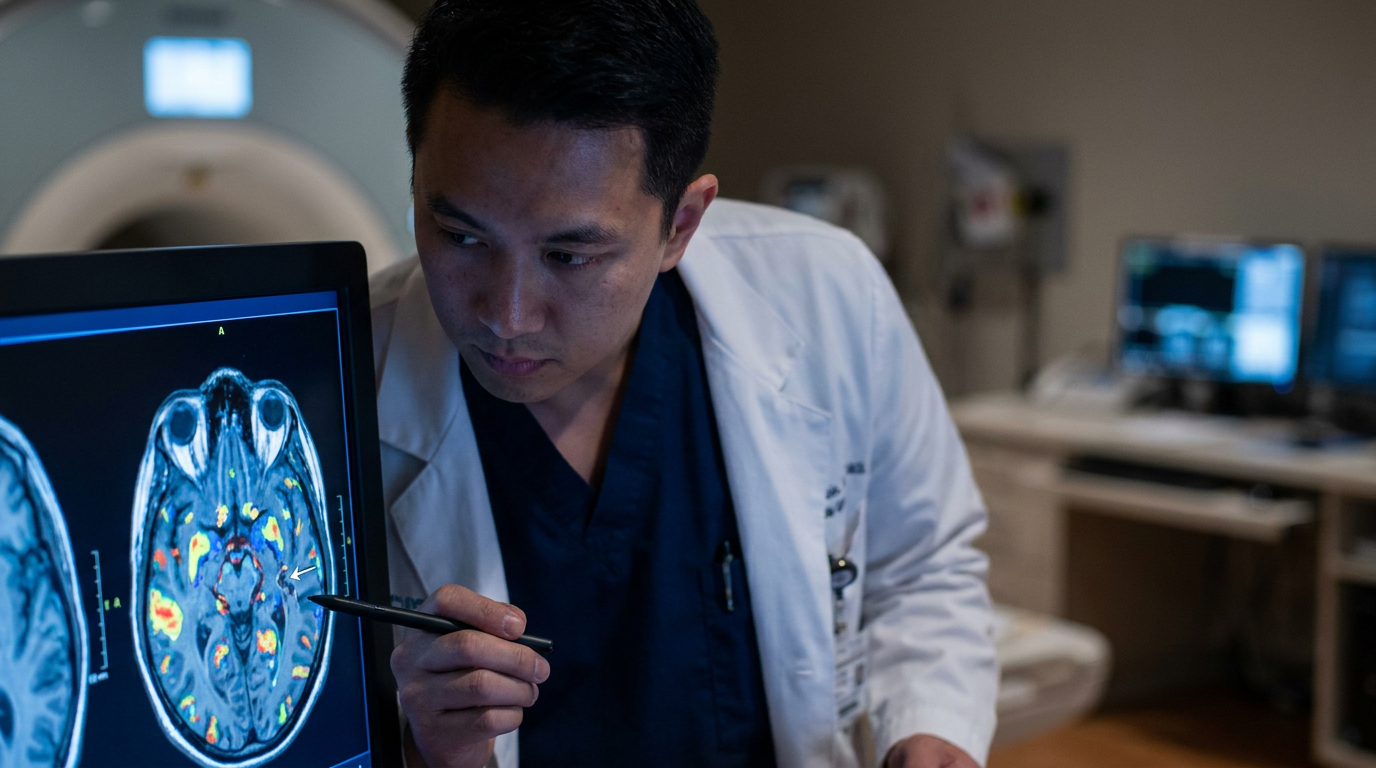
- The study investigated factors influencing functional MRI-based language lateralization prediction in patients with cerebral vascular malformations.
- This retrospective study included 24 patients with arteriovenous malformations, 11 with cavernomas, and 15 healthy controls.
- Frontal arteriovenous malformation patients exhibited significantly lower frontal lateralization indices than controls (p = 0.032, r = 0.435).
- The authors concluded that lesion type and location, specifically frontal arteriovenous malformations, influence language lateralization prediction.
- Clinicians should exercise caution interpreting functional MRI lateralization indices in patients with frontal arteriovenous malformations for patient safety.
Navigating Language Lateralization in Cerebral Vascular Malformations
Preoperative assessment of language lateralization is a critical component of neurosurgical planning, particularly for lesions near eloquent cortical areas. Functional magnetic resonance imaging (fMRI) is a standard non-invasive tool for this mapping, helping to minimize postoperative neurological deficits [1, 2]. However, cerebral vascular malformations (CVMs), such as arteriovenous malformations (AVMs) and cavernomas, present unique interpretive challenges [3, 4]. These lesions can induce significant neuroplasticity and alter local hemodynamics, potentially confounding fMRI signals and the accuracy of language mapping [2, 5]. Given that CVMs are a notable cause of intracranial hemorrhage and seizures often requiring surgery, precise language mapping is paramount for patient safety and functional preservation [6, 3, 4]. A recent study provides new data on how lesion characteristics may systematically affect these assessments.
Challenges in fMRI-Based Language Mapping
For patients with cerebral vascular malformations near language centers, fMRI-based prediction of hemispheric dominance is essential for guiding treatment and optimizing outcomes. The goal is to provide neurosurgeons with a clear map to minimize the risk of postoperative aphasia. This process, however, is complicated by two key factors. First, the brain may undergo functional reorganization, a form of neuroplasticity, in response to the lesion. Second, the vascular malformation itself can create unusual hemodynamic phenomena, altering the blood flow and oxygenation patterns that fMRI relies on to detect neural activity. Despite the clinical importance of accurate mapping, a clear understanding of which factors most influence laterality prediction in these patients has been lacking. To address this, researchers hypothesized that both the specific type of lesion and its anatomical location would have a measurable impact on fMRI-derived language lateralization.
Study Design and Methodology
This retrospective study was designed to quantify the impact of CVMs on fMRI-based language mapping. The cohort included 24 patients with arteriovenous malformations, 11 patients with cavernomas, and a comparison group of 15 healthy controls. During fMRI scanning, all participants performed a subvocal verb-generation task, a standard clinical paradigm used to robustly activate language-processing networks. The imaging data were analyzed using Statistical Parametric Mapping (SPM) 12, a widely accepted software package. Preprocessing steps included realignment to correct for patient head motion, coregistration to align the functional data with anatomical MRI scans, and smoothing to increase the signal-to-noise ratio. The researchers then applied a general linear model, a statistical method used to identify brain regions where activity significantly correlated with the language task. From this, they calculated lateralization indices (LIs), which provide a quantitative score of hemispheric dominance. These LIs were calculated independently for the frontal, temporal, and parietal lobes to enable a more granular, region-specific analysis of language organization.
Specific Impact of Lesion Type and Location on Lateralization Indices
Analysis of the fMRI data confirmed that all groups demonstrated clear language activation, with mean absolute lateralization indices (LIs) above 0.2. However, the study revealed that the type of vascular malformation significantly affected the degree of lateralization. The distribution of LIs varied significantly between the patient groups and healthy controls (p = 0.032, f = 0.34). Specifically, a significant difference was found between patients with arteriovenous malformations (AVMs) and the control group (p = 0.038, r = 0.628). This effect was driven by a specific combination of lesion type and location: patients with frontal AVMs showed significantly lower frontal LIs compared to healthy controls (p = 0.032, r = 0.435). A lower LI indicates less pronounced hemispheric dominance and a more bilateral pattern of language representation. In stark contrast, LIs in patients with cavernomas did not differ significantly from controls (p = 0.313), suggesting these lesions have a less disruptive effect on functional language organization as measured by fMRI. Interestingly, the analysis found no significant difference in LIs between lesions located adjacent to or distant from canonical language areas (p = 0.14), implying that lesion type may be a more critical factor than simple proximity.
Clinical Implications and Future Directions
These findings carry direct clinical relevance for any physician involved in the preoperative assessment of patients with CVMs. The study demonstrates that lesion type and location are not just incidental details but are factors that influence the interpretation of fMRI language mapping. The key takeaway is that frontal AVMs are associated with significantly lower lateralization indices. For the clinician, this suggests that fMRI results in these specific patients must be interpreted with heightened caution, as the reduced lateralization may reflect either true bilateral language representation or a hemodynamic artifact from the AVM itself. This ambiguity could impact surgical planning and risk assessment. Conversely, the finding that cavernomas did not significantly influence LIs may provide greater confidence in standard fMRI interpretation for that patient population. The authors conclude that while their results provide a crucial step forward, further research with larger patient cohorts is essential to confirm these findings, investigate the causal mechanisms, and better characterize the neuroplastic changes that occur in response to these distinct vascular lesions.
References
1. Alsop DC, Detre JA, Golay X, et al. Recommended implementation of arterial spin‐labeled perfusion MRI for clinical applications: A consensus of the ISMRM perfusion study group and the European consortium for ASL in dementia. Magnetic Resonance in Medicine. 2014. doi:10.1002/mrm.25197
2. Cirillo S, Caulo M, Pieri V, Falini A, Castellano A. Role of Functional Imaging Techniques to Assess Motor and Language Cortical Plasticity in Glioma Patients: A Systematic Review. Neural Plasticity. 2019. doi:10.1155/2019/4056436
3. Akers A, Salman RA, Awad IA, et al. Synopsis of Guidelines for the Clinical Management of Cerebral Cavernous Malformations: Consensus Recommendations Based on Systematic Literature Review by the Angioma Alliance Scientific Advisory Board Clinical Experts Panel. Neurosurgery. 2017. doi:10.1093/neuros/nyx091
4. Horne M, Flemming KD, Su I, et al. Clinical course of untreated cerebral cavernous malformations: a meta-analysis of individual patient data. The Lancet Neurology. 2015. doi:10.1016/s1474-4422(15)00303-8
5. Haroche A, Rogers J, Plaze M, et al. Brain imaging in catatonia: systematic review and directions for future research. Psychological Medicine. 2020. doi:10.1017/s0033291720001853
6. Connolly ES, Rabinstein AA, Carhuapoma JR, et al. Guidelines for the Management of Aneurysmal Subarachnoid Hemorrhage. Stroke. 2012. doi:10.1161/str.0b013e3182587839