
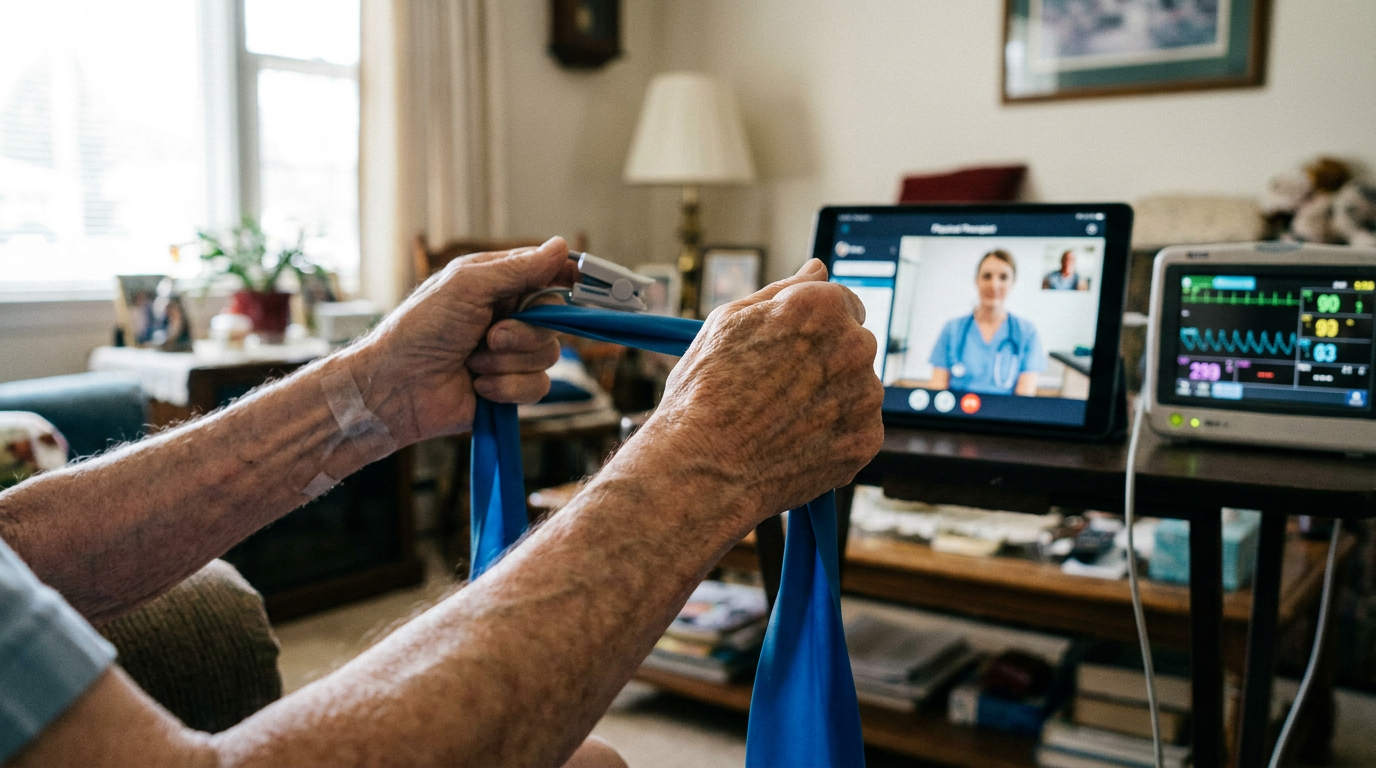
- Evidence is limited regarding remote, multicomponent rehabilitation for critical care survivors after intensive care unit discharge.
- This pragmatic, multicenter, randomized clinical trial included 429 adults discharged from 52 UK hospitals.
- The intervention group's mean EQ-5D-5L score was 0.69 versus 0.67 for standard care (adjusted mean difference, 0.04; 95% CI, –0.001 to 0.09; P = .05).
- The authors concluded that the 6-week rehabilitation program did not improve health-related quality of life at 8 weeks.
- Clinicians should note this intervention did not meet the minimum clinically important difference for quality of life.
Navigating Post-ICU Recovery: The Role of Remote Rehabilitation
Survivors of critical illness, particularly those requiring prolonged mechanical ventilation, frequently face a complex and protracted recovery marked by significant physical deconditioning, cognitive dysfunction, and psychological distress, a constellation of symptoms known as post-intensive care syndrome [1, 2]. These persistent impairments can diminish health-related quality of life for months or years after hospital discharge, highlighting the need for effective post-ICU rehabilitation strategies [3, 4]. While traditional in-person programs have shown some efficacy in improving physical function [3, 5], their utility is often limited by geographic barriers and patient mobility challenges [6]. In response, remote rehabilitation has been proposed as a more accessible alternative, yet its comprehensive impact on patient-centered outcomes remained to be rigorously investigated.
Study Design and Participant Characteristics
To evaluate the intervention under real-world conditions, investigators designed a pragmatic, multicenter, assessor-blinded, randomized clinical trial across 52 National Health Service hospitals in the UK. This pragmatic design is crucial as it aims to determine effectiveness in a typical clinical setting rather than a highly controlled research environment. The trial, which ran from December 2022 to November 2025, enrolled adults discharged from the hospital within the previous 12 weeks after an intensive care unit (ICU) admission. A key inclusion criterion was the requirement for mechanical ventilation for at least 48 hours, ensuring the study focused on a cohort with a high burden of post-ICU morbidity. Of 3705 screened patients, 429 (12%) were randomized. The cohort had a mean age of 55.4 years (SD, 13.9), included 184 female (42.9%) and 245 male (57.1%) participants, and demonstrated significant illness severity, with a median Acute Physiology and Chronic Health Evaluation II (APACHE II) score of 18 (interquartile range, 14 to 22) at ICU admission.
Intervention and Outcome Measures
The study compared a 6-week, remote, multicomponent rehabilitation program to standard care in survivors of critical illness. Investigators randomized 231 individuals to the intervention group and 198 to standard care. Commencing within 12 weeks of hospital discharge, the individualized intervention consisted of weekly symptom management, targeted exercise, psychological support, and peer support. The primary outcome was health-related quality of life at 8 weeks, measured with the EuroQoL 5-dimension 5-level questionnaire (EQ-5D-5L). This patient-reported utility score ranges from -0.285 (a state perceived as worse than death) to 1 (perfect health). Critically, the researchers predefined a minimum clinically important difference of 0.08, establishing a threshold for what would constitute a meaningful change for patients. Secondary outcomes included objective measures like leg strength and exercise capacity, as well as patient-reported fatigue, anxiety, depression, and illness perception. The intervention's acceptability and any adverse events were also tracked.
Primary Outcome: No Significant Improvement in Quality of Life
The study's central finding was that the 6-week remote rehabilitation program did not produce a clinically meaningful improvement in health-related quality of life at 8 weeks among ICU survivors who had required mechanical ventilation. At the 8-week follow-up, the mean EQ-5D-5L utility score was 0.69 (SD, 0.26) in the intervention group compared to 0.67 (SD, 0.27) in the standard care group. After adjusting for baseline covariates, the analysis yielded a mean difference of 0.04 (95% CI, –0.001 to 0.09; P = .05). Although the result approached statistical significance, the observed effect size of 0.04 fell short of the prespecified minimum clinically important difference of 0.08. This indicates that even if the small observed benefit is real, it is unlikely to be perceived as a substantial improvement by patients in their daily lives.
Secondary Outcomes: Mixed Effects on Physical and Psychological Measures
Although the intervention failed to meet its primary endpoint, it did yield benefits across several secondary measures. The analysis revealed that the program improved 4 of the 6 secondary outcomes evaluated. Participants in the intervention group demonstrated gains in leg strength and exercise capacity, along with reductions in self-reported fatigue and anxiety. The intervention was also found to be acceptable to patients with a favorable safety profile. In contrast, the program had no discernible effect on participants' perception of depression or their overall perception of their illness. This mixed picture suggests that while this short-term remote intervention may not be sufficient to alter a patient's global sense of well-being, it can effectively target specific and disabling sequelae of critical illness, such as physical deconditioning and anxiety.
Clinical Implications and Future Directions
This trial provides important guidance for clinicians managing the recovery of ICU survivors, a patient population for whom evidence on remote rehabilitation has been sparse. The primary conclusion is that a 6-week, multicomponent remote program is unlikely to substantially improve overall health-related quality of life within an 8-week period for patients recovering from prolonged mechanical ventilation. The final adjusted mean difference of 0.04 (95% CI, –0.001 to 0.09) did not meet the threshold for a clinically important change, a key consideration when counseling patients about expected outcomes from similar short-term programs. However, the documented improvements in leg strength, exercise capacity, fatigue, and anxiety suggest such interventions may still have a valuable role. Clinicians might consider them not as a comprehensive solution for post-intensive care syndrome, but as a targeted tool to address specific physical and psychological symptoms. Future research should investigate whether longer or more intensive interventions could produce more substantial quality-of-life benefits and explore outcomes beyond the 8-week mark. The transparent reporting of this trial, registered as ISRCTN11266403, contributes valuable, if null, findings to guide the development of more effective rehabilitation strategies for this vulnerable population.
References
1. Stewart J, Pauley E, Wilson D, Bradley J, Hart N, McAuley D. Factors to consider when designing post-hospital interventions to support critical illness recovery: Systematic review and qualitative evidence synthesis.. Journal of the Intensive Care Society. 2025. doi:10.1177/17511437241308674
2. Gesser AF, Campos ML, Artismo RS, Karloh M, Matte D. Impact of COVID-19 critical illness on functional status, fatigue symptoms, and health-related quality of life one-year after hospital discharge: a systematic review and meta-analysis. Disability and Rehabilitation. 2023. doi:10.1080/09638288.2023.2266365
3. Cazeta BBR, Queiroz RSD, Nacimento TS, et al. Effects of exercise interventions on functioning and health-related quality of life following hospital discharge for recovery from critical illness: A systematic review and meta-analysis of randomized trials.. Clinical rehabilitation. 2024. doi:10.1177/02692155241241665
4. Devlin JW, Skrobik Y, Gélinas C, et al. Clinical Practice Guidelines for the Prevention and Management of Pain, Agitation/Sedation, Delirium, Immobility, and Sleep Disruption in Adult Patients in the ICU. Critical Care Medicine. 2018. doi:10.1097/ccm.0000000000003299
5. Jones PJRA, Karahalios PA, Puthucheary PZA, et al. Responsiveness of Critically Ill Adults With Multimorbidity to Rehabilitation Interventions: A Patient-Level Meta-Analysis Using Individual Pooled Data From Four Randomized Trials*. Critical Care Medicine. 2023. doi:10.1097/CCM.0000000000005936
6. O'Neill B, Bradley JM, Connolly B, et al. Remote multicomponent rehabilitation compared to standard care for survivors of critical illness after hospital discharge (iRehab): a protocol for a randomised controlled assessor-blind clinical and cost-effectiveness trial.. NIHR open research. 2025. doi:10.3310/nihropenres.13910.2