
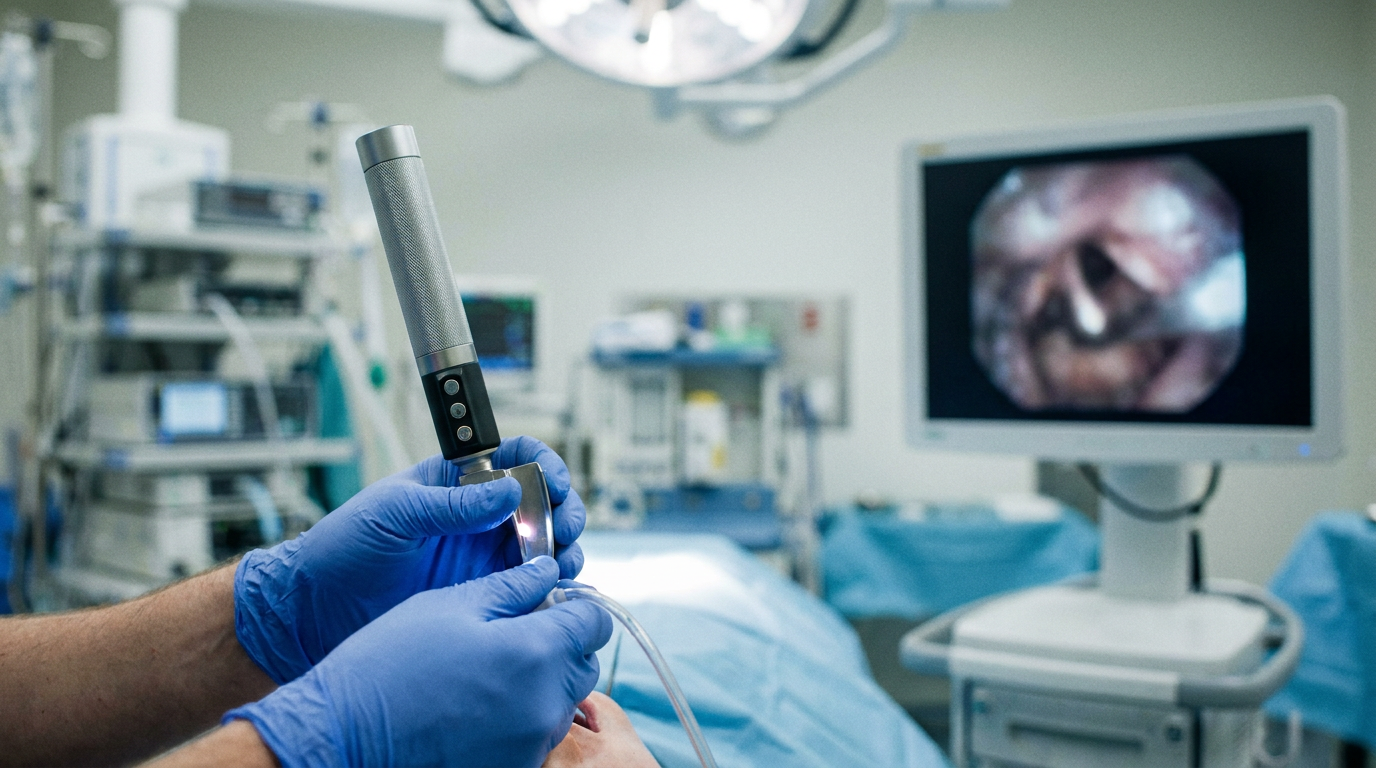
- This study compared the POGO score with visual analogue scale ratings for classifying difficult videolaryngoscopic tracheal intubation in children.
- This secondary analysis of a prospective observational study included 904 tracheal intubations in 809 children.
- POGO score showed poorer diagnostic performance (AUROC 0.52) than VAS (AUROC 0.79) for difficult intubation (p < 0.001).
- The authors concluded that the POGO score has poor diagnostic performance and low inter-rater reliability in children.
- Clinicians should consider the visual analogue scale as a more reliable indicator for predicting difficult pediatric videolaryngoscopic intubation.
Assessing Airway Visualization in Pediatric Videolaryngoscopy
Videolaryngoscopy is increasingly a first-line tool for tracheal intubation in diverse settings, from critically ill adults to neonates, often improving glottic visualization and first-attempt success compared to direct laryngoscopy [1, 2, 3, 4]. This technology can be particularly valuable in managing challenging airways, potentially reducing complications like esophageal intubation or aspiration [5, 3]. While its benefits are established, especially in populations with class 2 or 3 obesity [2], a key clinical question remains: how can clinicians best quantify the quality of the view obtained to predict intubation difficulty? The effectiveness of assessment tools is paramount for decision-making and patient safety, particularly in pediatric airway management [4, 6, 7], prompting investigation into which metrics provide the most reliable guidance.
Study Design and Patient Cohort
To address this question, researchers conducted a secondary analysis of the prospective observational PeDiAC study, focusing specifically on pediatric airway management. The investigation was designed to compare the clinical utility of two distinct methods for assessing the laryngeal view during videolaryngoscopy. The first was the percentage of glottic opening (POGO) score, an objective metric that quantifies the visible portion of the glottis. The second was a subjective rating on a visual analogue scale (VAS), where operators provided an immediate post-procedure score from 0 to 100 to grade their overall impression of the glottic view, with higher scores indicating a better view. Over a 16-month period, videolaryngoscopy was used as the primary intubation method. While VAS scores were recorded immediately by the operator, POGO scores were assigned later by analyzing video recordings of the procedures. The study included a large cohort of 904 tracheal intubations in 809 children, providing a robust dataset. Within this group, difficult videolaryngoscopic tracheal intubation was encountered in 47 cases (5.2%), establishing the baseline for evaluating each scoring tool's predictive power.
POGO Score's Diagnostic Performance for Difficult Intubation
The central finding of the analysis was the significant disparity in diagnostic performance between the two scoring methods for identifying difficult intubations. The study used the Area Under the Receiver Operating Characteristic (AUROC) curve to evaluate each test. This statistic measures how well a test can distinguish between two outcomes, in this case, difficult versus non-difficult intubations, where a score of 0.5 represents no better than random chance and 1.0 signifies perfect discrimination. The POGO score yielded an AUROC of 0.52 (95%CI 0.42–0.62), indicating its performance was barely distinguishable from a coin flip. In stark contrast, the operator's subjective VAS rating achieved an AUROC of 0.79 (95%CI 0.73–0.86). This substantial and statistically significant difference (p < 0.001) suggests that while the POGO score offers minimal clinical value for anticipating a difficult videolaryngoscopic intubation in children, the simpler, subjective VAS assessment provides a much more meaningful and discriminating evaluation of the laryngeal view.
Predicting Intubation Challenges and Adverse Events
The POGO score's poor predictive capacity extended across a range of procedural challenges and adverse outcomes. When evaluated for its ability to predict the need for multiple laryngoscopy attempts, the POGO score's AUROC was 0.46 (95%CI 0.40–0.51), compared to 0.66 (95%CI 0.61–0.71) for the VAS rating (p < 0.001). A similar pattern emerged for predicting multiple tracheal intubation attempts, with the POGO score's AUROC at 0.45 (95%CI 0.41–0.50) versus 0.64 (95%CI 0.60–0.68) for the VAS (p < 0.001). These results demonstrate that the POGO score does not reliably signal the likelihood of repeated procedural attempts. Furthermore, the score failed to predict intubations that become prolonged. For identifying procedures lasting longer than 90 seconds, the POGO score had an AUROC of 0.45 (95%CI 0.40–0.51), significantly underperforming the VAS rating's AUROC of 0.70 (95%CI 0.65–0.75) (p < 0.001). The POGO score was also a poor predictor of airway-related adverse events (AUROC 0.51 vs. 0.65, p = 0.030) and severe hypoxemia (AUROC 0.47 vs. 0.63, p = 0.047), reinforcing that the subjective VAS rating consistently provided more clinically relevant predictive information than the objective POGO score in this pediatric cohort.
Clinical Utility and Reliability Concerns
Beyond its poor diagnostic accuracy, the study exposed fundamental issues with the POGO score's practical utility and reliability. For a POGO score cutoff of less than 50%, the analysis found a low positive predictive value of 0.11 (95%CI 0.04–0.22) for difficult intubation. Clinically, this means that in nearly nine out of ten instances where the score predicted difficulty, the intubation was not, in fact, difficult. Compounding this, the score showed a low sensitivity of 0.13 (95%CI 0.05–0.27), indicating that it failed to identify the vast majority of actual difficult intubations that occurred. A final critical flaw emerged in its consistency. The study reported limited inter-rater reliability, with an intraclass correlation coefficient (ICC) of 0.61 (95%CI 0.47–0.72). An ICC in this range signifies only moderate agreement, suggesting that two different clinicians viewing the same airway could frequently assign different POGO scores. This lack of objectivity and reliability, combined with its poor predictive power, suggests the POGO score is an inadequate tool for assessing pediatric airways during videolaryngoscopy.
References
1. Carvalho CCD, Guedes IHL, Dantas MVM, et al. Videolaryngoscope designs for tracheal intubation in adults: a systematic review with network meta-analysis of randomised controlled trials.. Anaesthesia. 2025. doi:10.1111/anae.16597
2. Goh ZJ, Ang A, Ang S, et al. Videolaryngoscopy vs. direct laryngoscopy in class 2 and 3 obesity: a systematic review, meta‐analysis and trial sequential analysis of randomised controlled trials*. Anaesthesia. 2025. doi:10.1111/anae.16578
3. Araújo B, Rivera A, Martins S, et al. Video versus direct laryngoscopy in critically ill patients: an updated systematic review and meta-analysis of randomized controlled trials. Critical Care. 2024. doi:10.1186/s13054-023-04727-9
4. Kuitunen I, Räsänen K, Huttunen TT. Video laryngoscopy in neonate and infant intubation—a systematic review and meta-analysis. European Journal of Pediatrics. 2024. doi:10.1007/s00431-024-05839-2
5. Alsabri M, Abdelwahab OA, Elsnhory AB, et al. Video laryngoscopy versus direct laryngoscopy in achieving successful emergency endotracheal intubations: a systematic review and meta-analysis of randomized controlled trials. Systematic Reviews. 2024. doi:10.1186/s13643-024-02500-9
6. Rinaldi P, Garo ML. Tracheal intubation in adult patients with anticipated difficult airway: Hyperangulated versus Macintosh blade videolaryngoscopy: a comprehensive systematic review.. Anaesthesia Critical Care & Pain Medicine. 2026. doi:10.1016/j.accpm.2026.101761
7. Köhl V, Wünsch VA, Müller M, et al. Hyperangulated vs. Macintosh videolaryngoscopy in adults with anticipated difficult airway management: a randomised controlled trial. Anaesthesia. 2024. doi:10.1111/anae.16326