
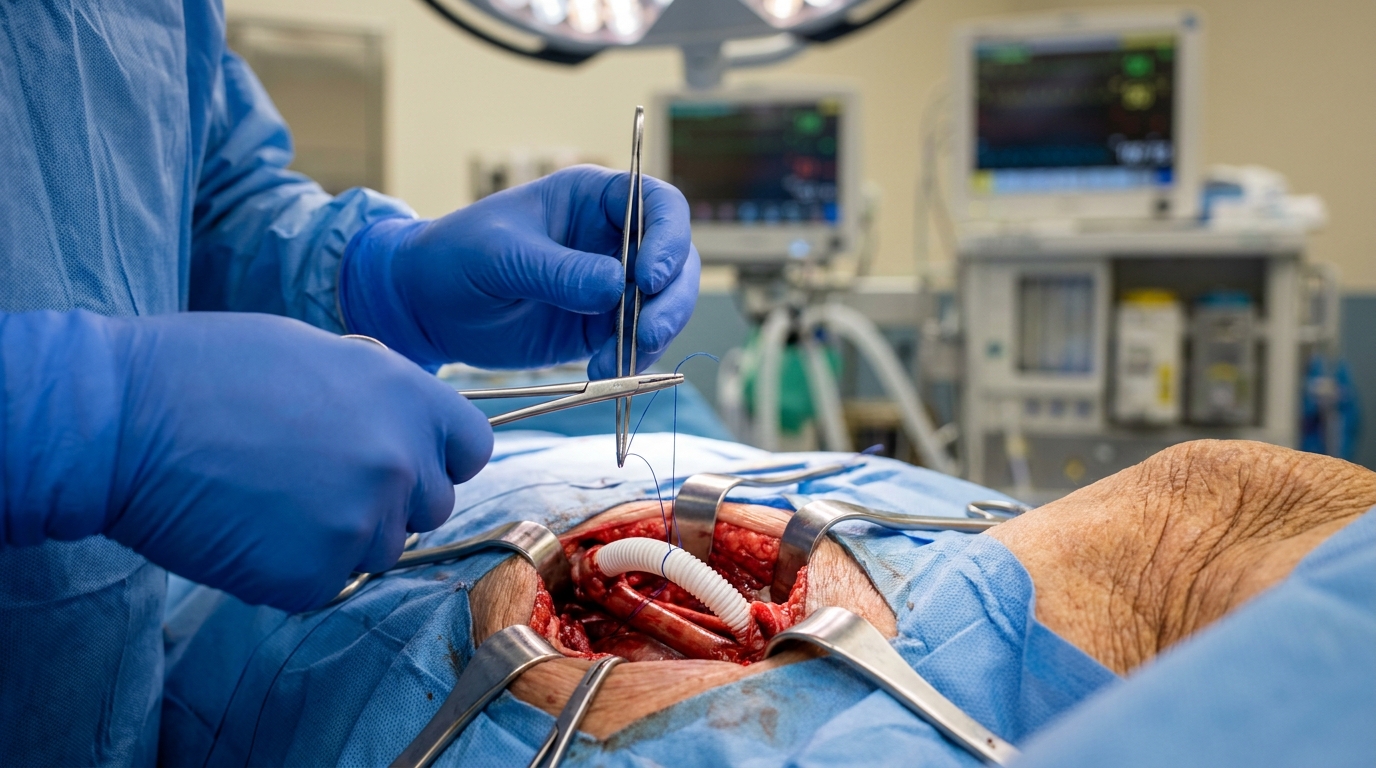
- Researchers investigated whether octogenarians face higher risks during suprainguinal bypass (surgical reconstruction of blood flow above the groin) for aortoiliac occlusive disease.
- This retrospective analysis of the Vascular Quality Initiative database included 1,397 octogenarians and 18,533 younger patients undergoing suprainguinal bypass procedures.
- Octogenarians faced higher 30-day mortality (9.3% versus 3.6%, p<0.001) and increased risk of myocardial infarction (adjusted odds ratio 1.59, p=0.002).
- The researchers concluded that advanced age significantly increases perioperative mortality and cardiac complications following surgical intervention for complex arterial blockages.
- Utilizing extra-anatomic bypass (rerouting blood flow outside the normal anatomical path) may reduce 30-day mortality risk (adjusted odds ratio 0.47) in octogenarians.
Revascularization Strategies in the Aging Aortoiliac Patient
Aortobifemoral bypass is the established standard for treating symptomatic aortoiliac occlusive disease, but its application in an aging population is complicated by diminished physiological reserves and high comorbidity burdens [1]. Patients undergoing major vascular reconstructions are inherently susceptible to myocardial injury, which is associated with a nearly threefold increase in one-year mortality [2]. While endovascular techniques have expanded treatment options, open surgical intervention remains necessary for complex lesions to achieve durable patency and limb salvage [3, 4]. For patients unable to tolerate the physiological stress of aortic cross-clamping, extra-anatomic alternatives such as axillofemoral or femorofemoral bypasses offer a less invasive method of restoring inflow [5]. A recent analysis of a large national registry now clarifies how these surgical choices specifically affect outcomes for patients over 80 years of age.
A National Registry Comparison of Surgical Cohorts
To investigate outcomes of suprainguinal bypass for aortoiliac occlusive disease, researchers analyzed data from the Vascular Quality Initiative database from 2009 to 2023. The study included 19,930 patients aged 51 to 89, who were stratified into two groups for comparison: 1,397 octogenarians (7% of the cohort) and 18,533 non-octogenarians (93%). This large-scale analysis revealed that octogenarians presented with a more complex clinical profile, including more severe comorbidities. The severity of vascular compromise was also more pronounced in the older group, who were significantly more likely to present with critical limb ischemia (a condition of severely restricted blood flow threatening limb viability) compared to non-octogenarians (56.1% vs. 45.6%; P < .001). This finding suggests that octogenarians often require intervention at a more advanced stage of disease, which can complicate surgical management.
Divergent Procedural Choices and Mortality Risks
Surgical management differed markedly between the two age groups, reflecting a clinical preference for less invasive procedures in older, more frail patients. Among octogenarians, surgeons primarily utilized extra-anatomic procedures like femorofemoral bypass (56.1%) and axillofemoral bypass (36.6%), with only 7.4% undergoing the more physiologically demanding aortofemoral or aortoiliac bypass. Conversely, non-octogenarians predominantly received aortofemoral or aortoiliac bypass (47.8%). This pattern suggests that for younger patients, clinicians prioritize the long-term patency of direct aortic reconstruction, whereas for octogenarians, the focus shifts to minimizing surgical trauma by using routes that avoid the abdominal cavity. The study's primary outcome, 30-day mortality, highlighted the increased risk in the older cohort. Octogenarians faced a 30-day mortality rate of 9.3%, significantly higher than the 3.6% rate in the non-octogenarian group (P < .001). To better understand this relationship, the authors used a Poisson spline model, a statistical technique that visualizes how risk changes continuously with age. This analysis showed that the significant association between age and the risk of 30-day mortality begins at 59 years, indicating a progressive increase in surgical risk that starts well before the eighth decade.
Quantifying Postoperative Complications and Long-Term Survival
After adjusting for potential confounders, the analysis confirmed that advanced age was an independent predictor of poor outcomes. Octogenarian status was associated with a nearly twofold increase in the risk of 30-day mortality (adjusted Odds Ratio [aOR] = 1.99, 95% Confidence Interval [CI] = 1.56-2.55; P < .001). This elevated risk persisted, as octogenarians also faced a doubled risk of one-year mortality (adjusted Hazard Ratio = 2.05, 95% CI = 1.78-2.36; P < .001). The data pointed specifically to a higher burden of postoperative cardiovascular events in the older group, including myocardial infarction (aOR = 1.59, 95% CI = 1.18-2.14; P = 0.002) and congestive heart failure (aOR = 1.46, 95% CI = 1.04-2.06; P = 0.028). Functional recovery was also more challenging, with octogenarians having a 1.56 times higher risk of postoperative non-ambulatory status (95% CI = 1.24-1.97; P < .001) and a greater likelihood of requiring a red blood cell transfusion (aOR = 1.16, 95% CI = 1.01-1.34; P = 0.039). Notably, the risks of respiratory complications, surgical site infection, intensive care unit stays longer than three days, and the need for reintervention were not significantly different between the age groups, suggesting the heightened risk for octogenarians is concentrated in cardiac and functional domains.
The Survival Advantage of Extra-Anatomic Reconstruction
To guide surgical decision-making in the highest-risk patients, a sub-analysis focused exclusively on the octogenarian cohort. This analysis compared outcomes between direct anatomical repairs (aortofemoral or aortoiliac bypass) and extra-anatomical bypass, a technique that re-routes blood flow through vessels outside their normal path to avoid the stress of a major aortic procedure. The findings revealed a substantial survival benefit for the less invasive approach. Within the octogenarian group, extra-anatomical bypass was associated with a 53% reduction in the odds of 30-day mortality compared to direct aortic bypass (aOR = 0.47, 95% CI = 0.25-0.88; P = 0.018). These results suggest that for octogenarians with aortoiliac occlusive disease, the reduced physiological demand of extra-anatomic reconstruction may be a critical factor for survival, potentially outweighing the long-term patency benefits of direct aortic repair. For the practicing clinician, these data support considering extra-anatomic bypass as a reasonable and safer primary strategy for limb salvage in selected high-risk octogenarians.
References
1. Zil-E-Ali A, Aziz F, Goldfarb M, Radtka JF. The implications of surgeon case volume and hospital volume on outcomes of aortobifemoral bypasses in obese patients.. Journal of vascular surgery. 2023. doi:10.1016/j.jvs.2023.01.208
2. Polok K, Biccard B, Chan MT, et al. Mortality and major postoperative complications within one year after vascular surgery: a prospective cohort study. Polskie Archiwum Medycyny Wewnętrznej. 2024. doi:10.20452/pamw.16645
3. Kim YH, Bae JI, Jeon YS, et al. Korean Guidelines for Interventional Recanalization of Lower Extremity Arteries. Korean Journal of Radiology. 2015. doi:10.3348/kjr.2015.16.4.696
4. Reijnen MM, Mezes P, Tigkiropoulos K. One-Year Clinical Outcomes of a Self-Expanding Covered Stent for Aortoiliac Occlusive Disease. Journal of Endovascular Therapy. 2025. doi:10.1177/15266028251399582
5. Yadavalli SD, Caron E, Colome D, et al. Outcomes following unilateral axillofemoral bypass versus crossover femorofemoral bypass in chronic limb-threatening ischemia patients.. Journal of vascular surgery. 2026. doi:10.1016/j.jvs.2025.10.025