
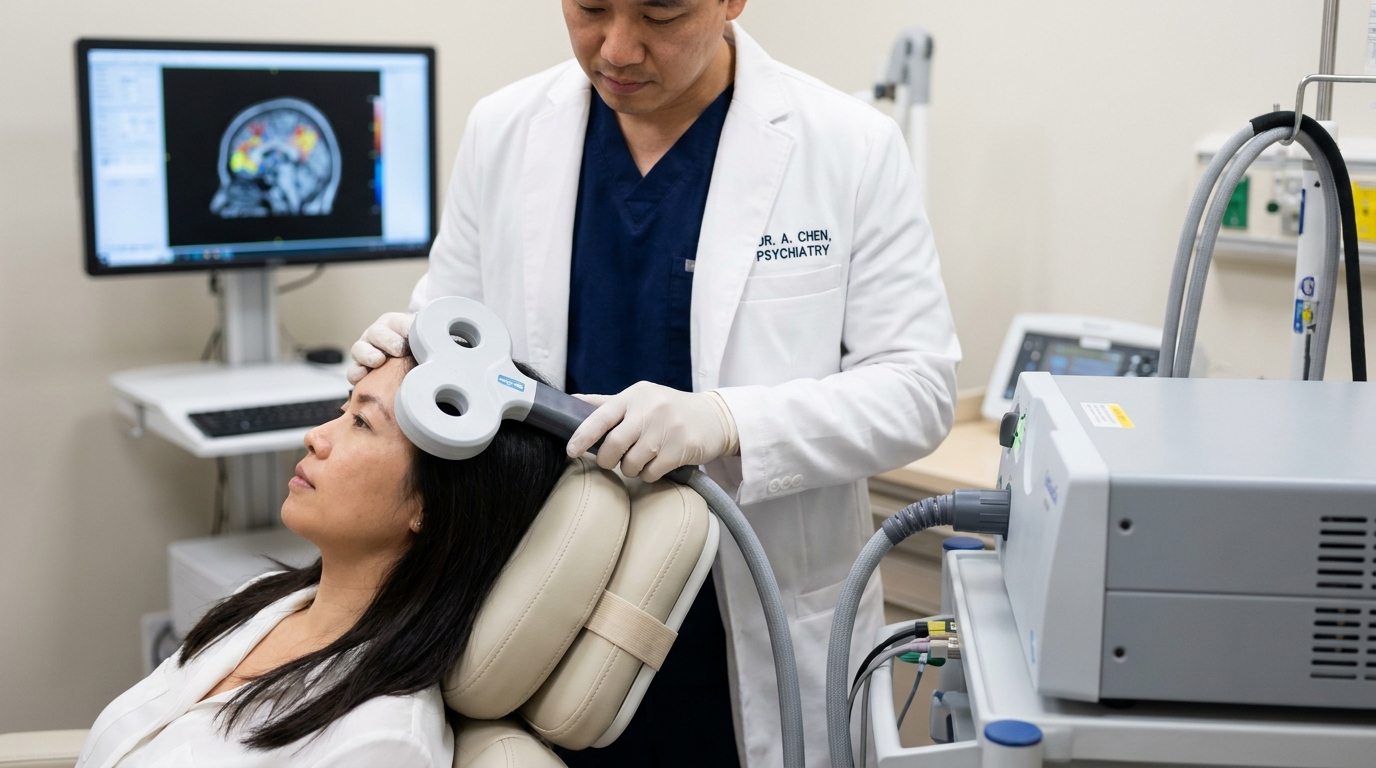
- Clinicians struggle to treat depression because its biological heterogeneity makes predicting response to interventions like repetitive transcranial magnetic stimulation difficult.
- Researchers analyzed 1,204 patients using normative modeling, a statistical method mapping individual brain connectivity deviations against 1,636 healthy controls.
- Subtype-2 showed significant anhedonia improvement (z = -2.92, p = 0.001), which was significantly greater than subtype-1 (z = -2.43, p = 0.046).
- The authors concluded that distinct connectivity patterns in the frontoparietal and default mode networks determine clinical response to brain stimulation.
- These findings suggest that biologically informed subtyping could eventually allow physicians to select the most effective candidates for magnetic stimulation therapy.
Refining Patient Selection for Neurostimulation in Depression
Major depressive disorder remains a leading cause of global disability, yet clinical outcomes are often limited by the significant heterogeneity of the disease. While repetitive transcranial magnetic stimulation (rTMS) has established efficacy as a non-invasive neuromodulation tool for treatment-resistant cases, its success rates vary widely across different patient populations [1, 2]. Current clinical practice largely relies on fixed stimulation protocols, as personalized approaches guided by standard imaging or electroencephalography have not yet consistently demonstrated superior antidepressant efficacy in large-scale trials [3, 4]. This lack of reliable predictive markers often leads to prolonged treatment courses for patients who may ultimately receive little benefit [5, 6]. To address this gap, a new study investigates whether mapping individual deviations in brain connectivity can identify stable biological subtypes to predict specific symptomatic responses to neurostimulation.
Mapping Individual Deviations in the Functional Connectome
To address the inherent variability in depressive disorders, researchers conducted an extensive analysis of 1204 patients spanning different states of depression. To establish a reliable benchmark for brain architecture, the study also included 1636 healthy controls to serve as a reference population. From this control group, the authors derived functional connectome normative models, a statistical framework that establishes a baseline of typical brain connectivity to flag individual deviations. This normative approach allowed the team to move beyond simple case-control comparisons and instead focus on how each patient's brain signature diverges from a standardized healthy template. By applying these models to the clinical cohort, the researchers generated individual deviation maps quantifying how a patient's brain wiring differs from the healthy baseline. To organize these complex data points into clinically relevant categories, the deviation maps were clustered using k-means, a machine-learning algorithm that groups patients based on shared biological characteristics. This process allowed the researchers to identify biologically informed subtypes of depression, ensuring that the resulting classifications were rooted in objective physiological patterns rather than subjective symptom checklists. The application of these computational techniques resulted in the identification of two reproducible subtypes that remained stable across various clinical and methodological conditions. For practicing clinicians, this methodology provides a neurobiological foundation for understanding why two patients with the identical diagnosis may exhibit vastly different responses to the same treatment.
Divergent Connectivity Patterns in Subtype-1 and Subtype-2
The analysis of the 1204 patients revealed that two reproducible subtypes emerged across various clinical and methodological conditions, providing a stable framework for understanding neurobiological diversity in depression. These subtypes were defined by distinct, nearly opposite patterns of functional connectivity, which refers to the temporal correlation of activity between different brain regions. In subtype-1, the researchers identified hyperconnectivity in the somatomotor and ventral attention networks. This indicates that the brain regions responsible for sensory processing, motor control, and involuntary orientation to external stimuli showed excessive synchronization compared to the healthy reference population. Conversely, this same group exhibited hypoconnectivity in the frontoparietal and default mode networks, reflecting a reduction in the functional coordination of areas involved in executive function, cognitive control, and internal self-referential thought. In stark contrast, subtype-2 showed the opposite pattern of brain wiring deviations. These patients were characterized by hypoconnectivity in the somatomotor and ventral attention networks, alongside hyperconnectivity in the frontoparietal and default mode networks. This increased synchronization in the frontoparietal network is particularly relevant for clinicians, as this network is the primary target for rTMS delivered to the dorsolateral prefrontal cortex. The stability of these two distinct neurobiological profiles suggests they represent fundamental biological signatures rather than transient clinical states, raising the prospect that future diagnostic tools could match patients to targeted interventions based on their specific network wiring.
Differential Response to Dorsolateral Prefrontal Cortex Stimulation
The researchers evaluated how these biological subtypes responded to repetitive transcranial magnetic stimulation (rTMS) targeting the dorsolateral prefrontal cortex, a standard site for neuromodulation in treatment-resistant depression. Clinical outcomes were specifically measured using the Snaith-Hamilton Pleasure Scale (SHAPS), an instrument used to quantify anhedonia. The results demonstrated that only subtype-2 showed significant improvement in anhedonia following rTMS treatment (SHAPS: z = -2.92, P = 0.001, False Discovery Rate). This finding suggests that the baseline hyperconnectivity in the frontoparietal network observed in subtype-2 may be a necessary physiological state for successful stimulation at the dorsolateral prefrontal cortex node. When comparing the two groups directly, the improvement in anhedonia for subtype-2 was significantly greater than that of subtype-1 (SHAPS, subtype-1 vs. subtype-2 efficacy: z = -2.43, P = 0.046, False Discovery Rate). This disparity highlights a potential biological barrier to standard treatment in subtype-1 patients, who exhibited hypoconnectivity in the target network. Furthermore, the degree to which a patient's individual brain connectivity matched a specific subtype predicted their clinical trajectory. Patients whose connectome deviation patterns more closely resembled subtype-2 had better anhedonia improvement (r = 0.48, P = 0.012). Conversely, patients whose deviation patterns were closer to subtype-1 had less improvement in anhedonia (r = -0.46, P = 0.016). These correlations suggest that the closer a patient's baseline brain architecture is to the subtype-2 profile, the more likely they are to benefit from this specific neurostimulation protocol.
Mechanistic Implications for Precision Psychiatry
To understand why these two groups responded so differently to neurostimulation, the researchers investigated the putative neurobiological mechanisms, or the underlying physiological processes, driving the differential response to rTMS. They specifically examined how the brain's connectivity patterns shifted in response to the treatment. The analysis revealed that only the pattern of deviation changes in subtype-2 was positively correlated with the anhedonia-related functional connectivity network mapping (r = 0.43, P < 0.001). This correlation indicates that the clinical improvement in subtype-2 patients was directly linked to the successful modulation of the specific neural circuits that govern reward processing and the experience of pleasure. These findings highlight potential avenues for subtype-targeted interventions in depression, suggesting a shift toward using baseline functional connectivity profiles to guide clinical decision-making. By identifying patients who exhibit the specific hyperconnectivity patterns of subtype-2, clinicians may eventually be able to more accurately select candidates for dorsolateral prefrontal cortex stimulation, sparing subtype-1 patients from a lengthy treatment unlikely to relieve their anhedonia. The authors conclude that while these preliminary findings provide a biological framework for personalizing neuromodulation, they warrant validation in larger randomized controlled trials to establish their utility in routine clinical practice.
References
1. Vida RG, Sághy E, Bella R, et al. Efficacy of repetitive transcranial magnetic stimulation (rTMS) adjunctive therapy for major depressive disorder (MDD) after two antidepressant treatment failures: meta-analysis of randomized sham-controlled trials.. BMC psychiatry. 2023. doi:10.1186/s12888-023-05033-y
2. Dalhuisen I, Bronswijk SV, Bors J, et al. The association between sample and treatment characteristics and the efficacy of repetitive transcranial magnetic stimulation in depression: A meta-analysis and meta-regression of sham-controlled trials.. Neuroscience and biobehavioral reviews. 2022. doi:10.1016/j.neubiorev.2022.104848
3. Terao I, Kodama W. Effectiveness of personalized repetitive transcranial magnetic stimulation for major depressive disorder: A systematic review and meta-analysis of randomized active-controlled trials.. Journal of affective disorders. 2025. doi:10.1016/j.jad.2025.04.028
4. Cao X, Deng C, Su X, Guo Y. Response and Remission Rates Following High-Frequency vs. Low-Frequency Repetitive Transcranial Magnetic Stimulation (rTMS) Over Right DLPFC for Treating Major Depressive Disorder (MDD): A Meta-Analysis of Randomized, Double-Blind Trials.. Frontiers in psychiatry. 2018. doi:10.3389/fpsyt.2018.00413
5. Jin MX, Qin PP, Xia AWL, et al. Neurophysiological and neuroimaging markers of repetitive transcranial magnetic stimulation treatment response in major depressive disorder: A systematic review and meta-analysis of predictive modeling studies.. Neuroscience and biobehavioral reviews. 2024. doi:10.1016/j.neubiorev.2024.105695
6. Gamboa L, Palha-Fernandes E, Bragança M. Non-inferiority of Accelerated vs. Repetitive Transcranial Magnetic Stimulation in Major Depressive Disorder: A Systematic Review.. Clinical psychopharmacology and neuroscience : the official scientific journal of the Korean College of Neuropsychopharmacology. 2025. doi:10.9758/cpn.25.1297