
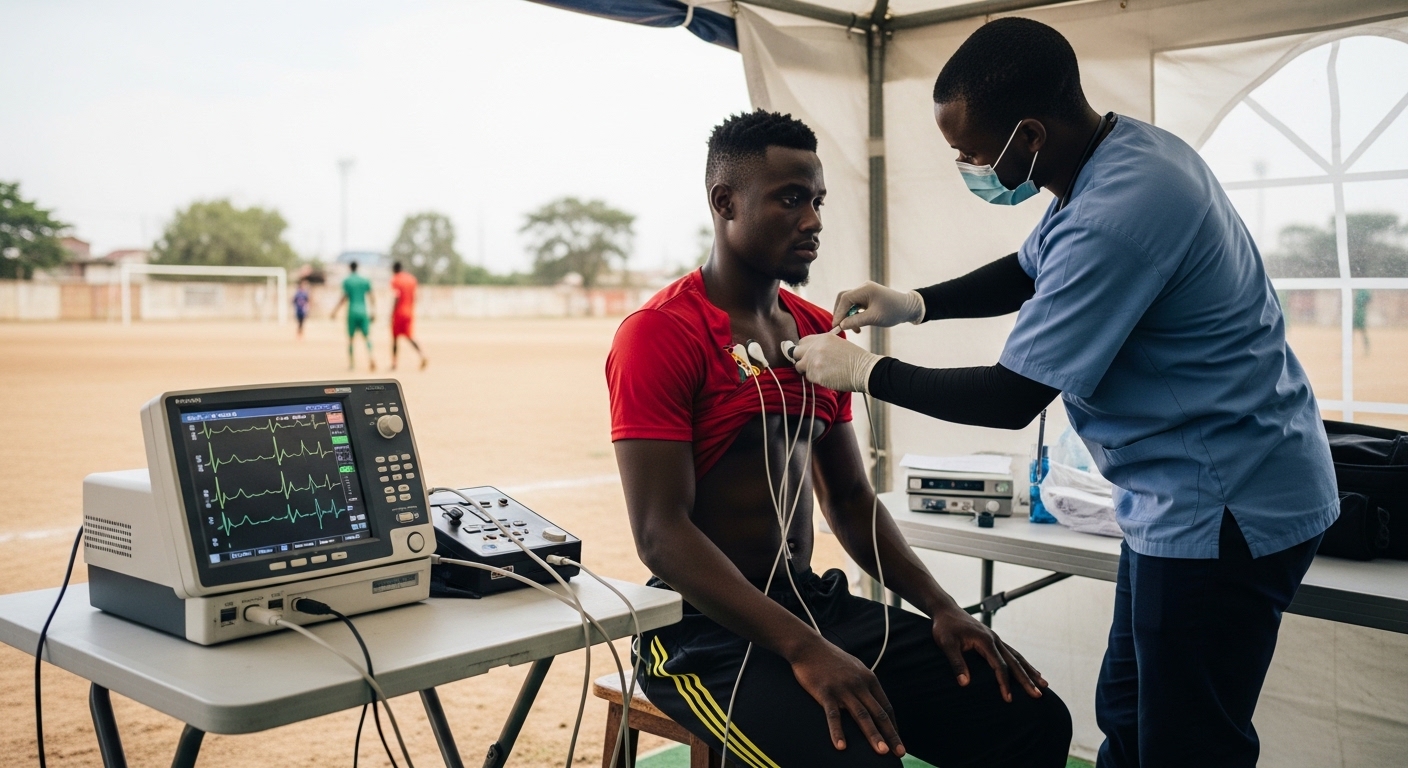
- This study investigated cardiovascular screening and emergency preparedness to prevent sudden cardiac death in Cameroon football.
- A cross-sectional survey included 211 participants from 54 football clubs and six national teams in Cameroon.
- Only 45.5% of participants reported ECG inclusion in screening, and AEDs were available in just 9.0% of matches.
- The authors concluded that urgent interventions are needed to improve sudden cardiac death prevention across Cameroon football.
- Priorities include better cardiovascular screening with ECGs, CPR training, and increased access to automated external defibrillators.
Preventing Sudden Cardiac Death in Athletes: A Global Challenge
Sudden cardiac death in athletes, while infrequent, represents a significant clinical challenge, often arising from undiagnosed structural or electrical cardiac abnormalities [1, 2]. Major cardiovascular organizations, including the European Society of Cardiology, have established guidelines emphasizing cardiovascular disease prevention through comprehensive screening and timely emergency response [3, 4]. These protocols aim to detect conditions such as hypertrophic cardiomyopathy, arrhythmogenic right ventricular cardiomyopathy, and congenital coronary anomalies before they become catastrophic [1, 2]. Furthermore, recommendations consistently highlight that survival following sudden cardiac arrest depends heavily on the immediate availability of trained personnel and automated external defibrillators (AEDs) [2]. However, the practical implementation of these standards varies widely, and a recent study from Cameroon offers a detailed assessment of these preventative measures in a professional football environment.
Assessing Cardiovascular Risk and Emergency Readiness in Cameroon Football
The need for robust cardiac safeguards in sports was tragically underscored by the on-field death of professional footballer Marc-Vivien Foé in 2003, an event that catalyzed efforts to prevent sudden cardiac death (SCD) in football worldwide. Building on this context, a recent cross-sectional study sought to evaluate the current cardiovascular screening strategies and emergency response plans within football clubs across Cameroon. Between 1 June and 30 August 2024, researchers administered in-person questionnaires to the technical and medical staff of the country's domestic professional and amateur leagues, as well as its national teams. The survey focused specifically on cardiovascular screening practices and preparedness for sudden cardiac arrest (SCA), including crucial metrics like cardiopulmonary resuscitation (CPR) training and access to automated external defibrillators (AEDs).
Prevalence of Cardiac Events and Screening Practices
The investigation captured data from 211 participants representing 54 different football clubs and six national teams, revealing a high burden of adverse cardiac events. Among the events reported, a stark 74.9% resulted in death. The circumstances of these events were overwhelmingly linked to athletic exertion, with 55.2% occurring during a match and 23.2% during training sessions. Only 1.9% occurred at home. Despite this clear on-field risk, the study found significant gaps in preventative screening. While 76.1% of participants reported that cardiovascular screening occurs during the precompetition medical assessment, the quality of this screening is inconsistent. Critically, only 45.5% of organizations provide screening that includes an electrocardiogram (ECG). This omission is clinically significant, as an ECG is a fundamental, noninvasive tool for detecting the underlying electrical and structural heart conditions that predispose athletes to SCD.
Emergency Preparedness: Training and AED Access Deficiencies
Beyond screening deficiencies, the study uncovered profound weaknesses in the emergency response infrastructure for SCA. Effective response hinges on a coordinated chain of survival, yet the data show critical links are missing. Training in basic life support was notably low, with only 37% of participants trained in cardiopulmonary resuscitation (CPR). Training in the use of an automated external defibrillator was even less common, reported by just 22.7% of participants. This lack of trained responders severely limits the potential for effective intervention in the crucial first minutes of an arrest. Compounding this issue was a critical shortage of equipment. An AED was rarely available during matches (9.0% of cases) or training (7.6%). In a particularly striking finding, no responding club from the domestic or professional leagues reported owning an AED; only the national teams confirmed their availability. This creates a dangerous environment where an athlete's survival may depend entirely on which team they play for.
Urgent Interventions Needed for Athlete Safety
The study's findings collectively point to an urgent need for systemic interventions to prevent SCD in Cameroon football. The high mortality rate for cardiac events (74.9%) is unacceptable and directly linked to deficiencies in both screening and emergency response. The authors conclude that implementing better cardiovascular screening strategies that consistently include an ECG, expanding CPR and AED training, and improving access to defibrillators are immediate priorities. For practicing physicians, these data from Cameroon serve as a powerful case study on the gap between established sports medicine guidelines and their real-world application, particularly in settings with limited resources. The findings underscore the importance of advocating for structured, evidence-based safety protocols that include not only pre-participation screening but also a robust, well-rehearsed emergency action plan. Such comprehensive programs are essential to meaningfully reduce the risk of tragic and preventable deaths in athletic populations.
References
1. Sanghvi M, Dhall E, Chahal CA, et al. Hypertrophic cardiomyopathy management: a systematic review of the clinical practice guidelines and recommendations. 2025. doi:10.1093/ehjqcco/qcae117
2. Priori SG, Blomström‐Lundqvist C, Mazzanti A, et al. 2015 ESC Guidelines for the management of patients with ventricular arrhythmias and the prevention of sudden cardiac death. European Heart Journal. 2015. doi:10.1093/eurheartj/ehv316
3. Visseren FL, Mach F, Smulders YM, et al. 2021 ESC Guidelines on cardiovascular disease prevention in clinical practice. European Heart Journal. 2021. doi:10.1093/eurheartj/ehab484
4. Members: AF, Perk J, Backer GD, et al. European Guidelines on cardiovascular disease prevention in clinical practice (version 2012): The Fifth Joint Task Force of the European Society of Cardiology and Other Societies on Cardiovascular Disease Prevention in Clinical Practice (constituted by representatives of nine societies and by invited experts) * Developed with the special contribution of the European Association for Cardiovascular Prevention & Rehabilitation (EACPR). European Heart Journal. 2012. doi:10.1093/eurheartj/ehs092